

West Jordan Bids Farewell to Police Chief Ken Wallentine
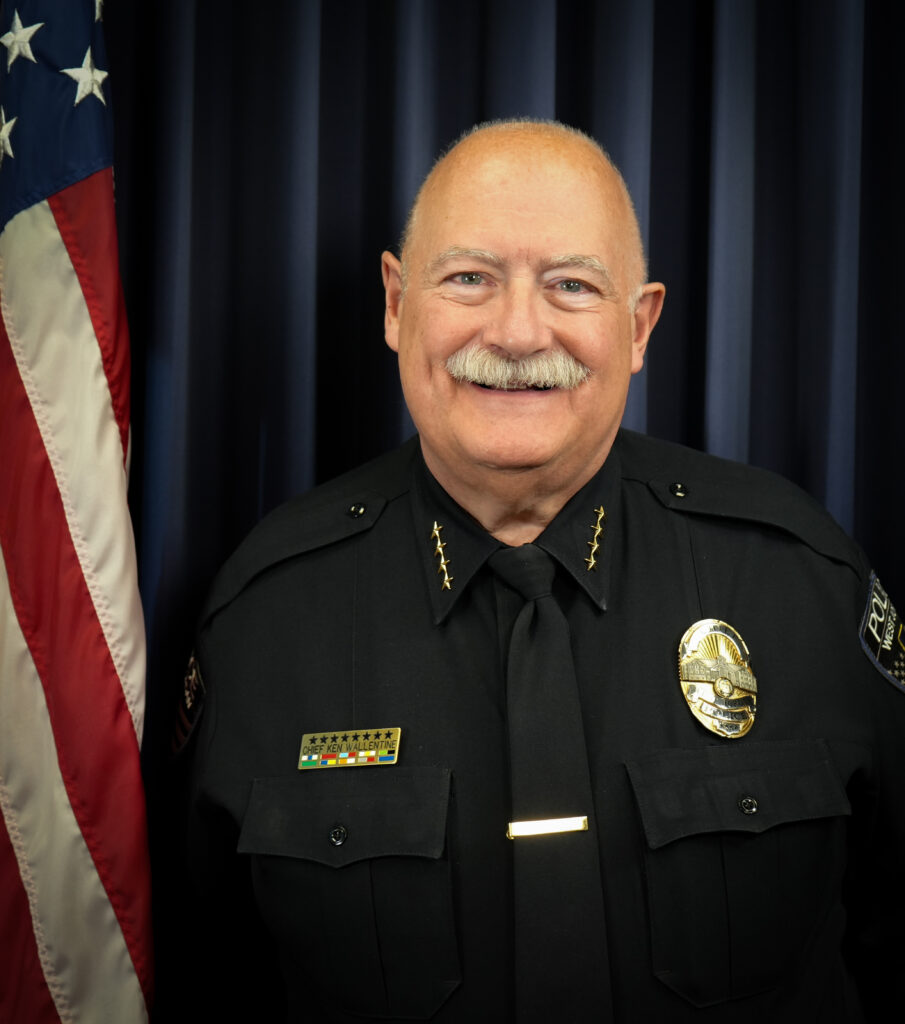
The day before the new police chief Jeremy Robertson takes the oath of office, I sat down with Ken Wallentine, who is, starting today, November 19, 2025, our former police chief. I had asked for an interview to talk about his career and legacy. In true fashion, he was reluctant to speak but he didn’t have to tell me much. What I have personally witnessed in the past seven years is plenty of testimony of his impact on West Jordan’s police department.
I met Wallentine the day he was sworn in as chief in 2018, after a hiatus in leadership when Doug Diamond retired in April that same year. This appointment came after 35 years as a beat officer, a public attorney, a legal expert and editor for Xiphos, a national criminal procedure newsletter, and a use-of-force consultant for over a dozen national police departments.
What I, and most people who interact with him, seem to remember is not his list of qualifications, nor his pithy quotes; though quotations are part of his daily vernacular, they wouldn’t have any teeth if he didn’t follow the advice himself.
One of the first things Wallentine said to me that day was that he would not be standing in the council chambers that day if it were not for an eight-grade teacher. “She put me in the path of success at a time no one thought I’d have any intellectual power,” he said. He is referring to “resource” classes.
Pointing to the influence of someone else who taught him well is his way of teaching. He also quotes his grandfather, a rural town marshal who raised him for much of his childhood. “He taught me to treat people the same and treat them decently” and “he taught me to tell the truth.”

And this is how he ran the police department. Before his supervision, the West Jordan Police Department had excellent officers, but was prone to “unneeded competition,” Chief Jeremy Robertson said.
In his seven years of service, the department has prioritized formal and informal mental health resources for their officers. You know that you have major trauma when you break your therapist. Before Wallentine, there may have been some mental health resources available for officers, but it was often a therapist with no understanding of police work. Fellow officers were of the “suck it up” mentality and weren’t much help to each other either. This is common throughout law enforcement, but is no longer the truth in West Jordan.
I spend a lot of time with police officers on official business, but what I hear from them is more than their plans and achievements. I often leave a call with a West Jordan officer in tears because they restore my hope and faith in humanity. A SWAT member once told me, after he described the high-stakes situations he regularly faces that involve human cruelty and violence, that “this isn’t a bad world, there are just bad things in it.” If a police officer can say that, perhaps the rest of us can too.
Or, I’ll leave a meeting with a room full of officers that have been smiling and teasing each other for a good hour straight, all while planning how to help the community through more than punishment, but through outreach and compassion. They shake each other’s hands, congratulate each other on jobs well done and genuinely enjoy the time they spend together.
“We are far more attuned to the impact on officers and their loved ones of the events that challenge our resilience and well-being. Because we are more attuned we are much better at taking care of our people,” Wallentine said.
Within West Jordan’s ranks there is less competition and more cooperation than there used to be. Nearly ⅔ of the 135 officers in West Jordan’s employ were hired by Wallentine and his deputies. His approach to hiring goes against many conventional processes.
- Integrity
- Motivation
- Capacity
- Knowledge
- Experience
“If you don’t have motivation, it matters not what your capacity to work is. If you don’t have the capacity to work, the capacity to learn, or the capacity to serve, it doesn’t matter what you know. We can give you knowledge. At the end of the day we can give you experience, but those are far, far less important than your integrity, your motivation, and your capacity,” he said. “Chief Robertson and Chief Bell helped me pick the right people by following a general approach to who we have in the door, and that’s what makes this place a delightful place to work.”
Back in 2020 when we talked about the “defund the police” movement he said, “No one, no one, dislikes a bad cop more than a good cop. We have the responsibility to police our own profession. I’m all for reform steps; I’m all for more transparency in police discipline records. One of the things we’re trying to do is listen very hard.”
In a presentation to the City Council in 2022, he told them that “I can’t rely on ‘I think it would never happen.’ I have to rely on specific training, specific policy to teach officers to step in appropriately in those situations and make sure they don’t happen.”
Every use of force in West Jordan is reviewed. Later, he told me that “If you use force in the West Jordan police department, a sergeant looks at it immediately, that night,” he said. “Within 48 hours, a lieutenant looks at it and makes sure the report has been entered. Our professional standards, and internal affairs looks at it, and it goes to a deputy chief, then to the chief of police. We review [and ask] ‘Are our officers’ behaviors proper? Are our trainings proper?’”
I’ve seen him interact with his fellow officers on the fly. I’ve seen him give formal presentations to civic leaders. I’ve seen him speak and interact with local religious leaders at the Faith in Blue celebration. He is always engaged with his full attention, from reporters to elected officials, his attention is in the moment with that person.
That genuine engagement comes from the days, that are most likely many for a police officer, that life was tough but the support of others keeps him going. On the days where he faced the toughest moments on the job he said, “All of the days when I thought it was too much, I’d done my time, someone could do it better; every single time, someone encouraged me to go on.”
It was the people that always brought him back to work. “I know that someone I’m going to interact with will rekindle that spark inside all of us that flickers and fails; someone comes along and ignites it.”
Though credentials never tell the whole story, they do hint at the path he has walked. Along that path, he has seen the worst and the best that humans are capable of. “We are human and susceptible to human frailties, human weaknesses, human mistakes, but we also are capable of infinite goodness, infinite kindness and personal heroism.”
On this, one of his last days in the chief’s chair, two school resource officers poked their heads in with the biggest smiles on their faces. As for most officers, their days are also not easy. It was obvious that coming to see the chief was not a punishment or an extra administrative step they needed to take, but a pleasure.
The last words in the interview were spoken by our new Chief Robertson, and sums up Wallentine’s affect everywhere he goes .“He’s been the best mentor for me that I could imagine over these last seven years,” he said, “But he’s really the best person. He’s been a great representative of law enforcement. He’s done more for law enforcement than really anybody else I’ve ever known. I’m happy he’s going out on a very positive note, having that influence on so many different organizations across the state, really across the country.”
The words of this tribute to Ken Wallentine would not be complete without his list of his “Top 10 Things to Live By”, that he teaches his children, officers, and everyone he encounters.
- Always answer the phone when your most-loved person calls, even if in the middle of speaking with the chief. Answer in an outward voice (not an outdoor voice).
- Keep a post-it notepad on your desk in case someone wants to leave you a note (be open to how others want to communicate with you).
- Fail fast, then move on.
- Talk nice, think mean.
- Don’t take yourself too seriously. I don’t and I won’t.
- Lead, follow, or get out of the way.
- The things that truly count usually can’t be counted. Things that can be counted usually don’t count.
- There is more to life than increasing its speed.
- I don’t see the world as it is. I see the world as I am. I am more successful when I endeavor to see the world as it is.
- The three hardest things in life: 1) Admitting that you are wrong; 2) including the excluded; 3) exchanging love for hate.
By Erin Dixon, former journalist for City Journals, and contract government writer