

Artist Forges Giant Steel Sugar Beet for Arts Center
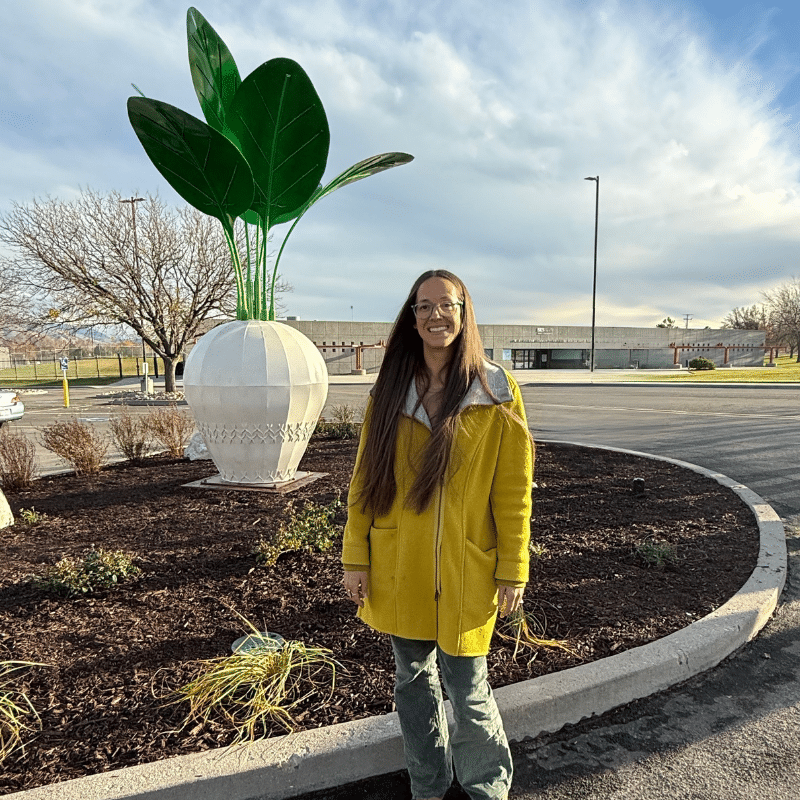
Once covered by crops, sheep and dairy farms, West Jordan has transformed from agricultural country to the third most populated city in Utah.
The Canyon View Credit Union Community and Arts Center (8105 S. 2200 W.) stands where a sugar factory once processed the sugar beets grown and harvested in the valley. In its lifetime, it turned 4,910,869 tons of sugar beets into 13,163,157 hundred-pound sacks of sugar. The sugar factory also conducted crop research and was able to solve many sugar beet crop diseases, including the dreaded “curly top.”
The Beet
To honor the agricultural heritage of our city, artist Laura Erekson forged a sugar beet made entirely of steel that now stands outside the new Arts Center. It is made of metal sheets, an internal rod structure and seven skyward-reaching leaves. She formed the entire beet by hand in her garage studio, then assembled the massive pieces on-site. From July to mid-November, she worked many long nights. Construction was “very intense,” she said, and the first of this size and scale for her.
It’s a “work that celebrates West Jordan culture and history of agriculture and sugar beets,” she said.
The work is named Rooted and represents “coming together as a community,” she said, both as neighbors and as people connected to the earth. “We’re forgetting that it’s important to know where we come from. [The land] is part of us. We can’t just pave our way over everything and ignore it. It deserves some respect. We work together.”
Erekson Art
Erekson earned a Bachelor of Fine Arts (BFA) from Brigham Young University, and Masters of Art Teaching from George Mason University.
She then installed art at the Hirshhorn Museum and Sculpture Garden, working with many other artists’ creations. A lot of her own work, including the beet, includes “found objects” for the visual effect of hard and soft and bringing the two together. Many of her works include imprints, or sets of needle-nosed pliers, a tool she used often when she worked construction to get herself through school.
Her pieces also often “pay homage to where we come from, how we are connected to land, connected to place. Through honoring and remembering that, hopefully we are influencing our present moment for the better.”
You can find her art in the Springville Museum of Art, at shows and galleries in Park City, and at the Church History Museum. You can also find prints and details about her collections online and Instagram.
Growth as an Artist
When she and her husband moved back to Utah, she gave birth to their first child two days after they landed.
“Becoming a mother expanded my soul in ways I never thought possible. I feel everything more deeply, see things more clearly. I understand the fragility of life as well as its beauty.” – Erekson
That creative collaboration with her children reflects a larger shift in how she views her art, so she included her children as part of the beet. “They actually helped with the texture around the base, peeled off leaves and pliers,” she said. “They are my four studio assistants. So they felt ownership and satisfaction and joy in [the beet], they each did a little drawing that I laminated and inserted them into a leaf. Their artwork is encased in the beet forever.”
Through motherhood, she and her art have been transformed.“My work would not be nearly as good without being a mother. I am a better artist, there’s more depth, more meaning.”
With Rooted, the city preserves a piece of its past while embracing its future. The beet is now a permanent art fixture to the north of the Art Center, standing as a reminder of West Jordan’s agricultural roots.
By Erin Dixon